Send
Close Add comments:
(status displays here)
Got it! This site uses cookies. You consent to this by clicking on "Got it!" or by continuing to use this website.nbsp; Note: This appears on each machine/browser from which this site is accessed.
Studying and learning
1. Studying and learning
Note: Here is a collection of notes and ideas that have been combined from several different documents that I have written in the past. These notes were written in 1997 but still apply today.
(revised 2020)
2. College educational goals
Some college educational goals include the following.
learn how to learn (the only way you can do this is by learning something)
learn how to handle opportunity costs related to time (the best way is to have so much work to do that you have to decide what is most important)
In high school, the teachers responsibility is to teach the students. In college, the professors responsibility is to make learning available to the student.
3. Pace of education
As you progress in your education, which, due to reengineering, is now a lifelong pursuit and not just a few years and done forever event, the pace of learning increases.
In high school you might spend a month (i.e., 20 hours) on one subject, with lots of in-class exercises and relatively little out of class work.
As an undergraduate, you might spend a week (i.e., 3 hours) on the same material, with some in-class exercises, but more out of class work (i.e., 3 to 6 hours) per week.
In graduate study, you typically would spend one day (i.e., 40 minutes) on the same material, with almost no in-class exercises, and much more out of class work (i.e., 5 to 15 hours per week).
It is up to you do make time to do the required study.
4. Thinking
It is as much a goal to learn how to think like a computer professional than it is to learn the details of what a computer professional does. In five years, you will probably be using hardware and software that do not now exist. But, although some of the details will change, many of the concepts will remain the same.
To learn to be (and think like) a computer scientist, it helps to be taught by a computer scientist.
5. Business process reengineering
Have you ever heard this: ;"We need to teach students while they sit in front of a computer."
Reengineering response: What one must know about computers in the workplace can be learned in the workplace. Rather it is the systems thinking that lies at the heart of a good computer science curriculum that leads me to recommend it. What one learns in computer science will help in any business context. Hammer, M. (1996). Beyond reengineering. New York: Harper Business., p. 237.
6. Understanding
Chinese proverb:
You hear something, you forget it.
You see something, you remember it.
You do something, you understand it.
For example, if you cannot do base conversion, then you do not understand it, even though you may think that you do.
7. Programming advice
Try taking ideas from classes outside of computer science and try programming them. The more you do this, the better you will get, and the more you will understand.
8. Memorization
It is quite an advantage to be able to pick up and remember details quickly. One way to train the mind is to exercise it by memorizing material. Only by remembering many details can you move to the next level of being able to use those details to advantage.
9. Bloom's educational levels
10. Bloom's taxonomy
 Bloom's taxonomy
 of educational goals Bloom, B. (1956). Taxonomy of Educational Objectives.
Handbook I: Cognitive Domain. New York: David McKay.. , from top to bottom, are as follows.
Evaluation
Synthesis
Analysis
Application
Comprehension
Knowledge
(image added 2020)
A curriculum should be designed top-down (general to specific); it should be goal-oriented. The implementation, however, must be done bottom-up (specific to general) as a sequence of events in time. A top-down design can be obtained from Bloom's taxonomy of educational goals.
11. Evaluation
The goal of evaluation is that of general problem solving ability, with or without the assistance of a computer.
The evidence of such ability is usually seen in the accomplishment of a (graduate) thesis or (undergraduate) senior project.
12. Knowledge
The foundation is knowledge, the collection of facts and terminology that form the building blocks in the domain in which problems are being solved.
13. Curricula
A curriculum should start at the foundation and arrive at the goal, usually within certain constraints (e.g., credit hour limitations).
14. Programming process hierarchy
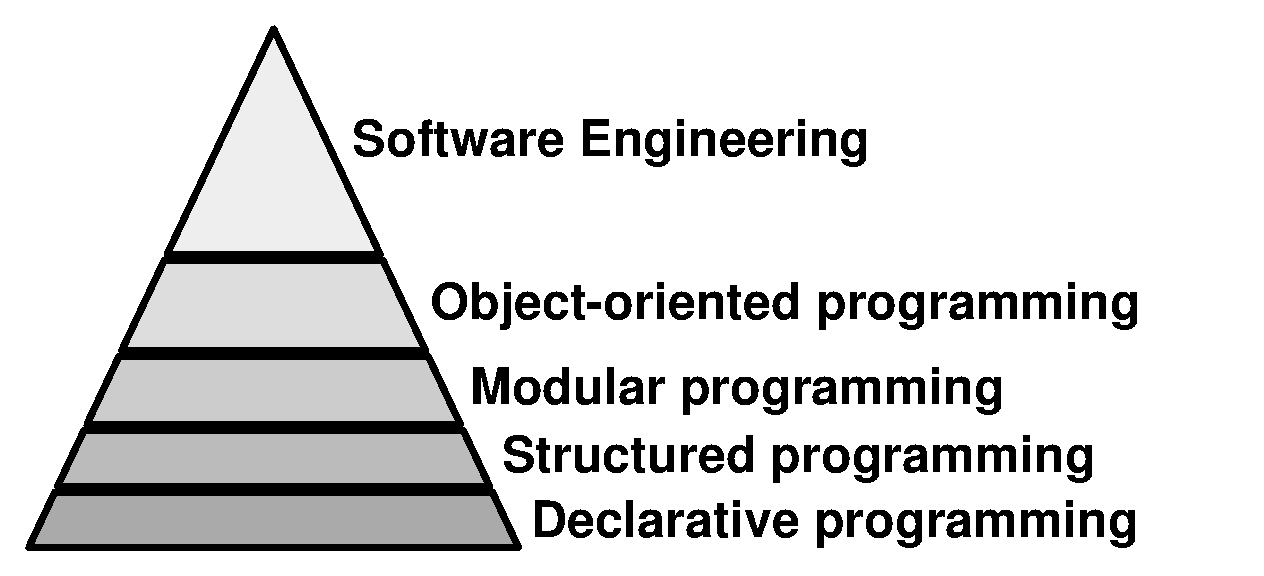 Software Engineering
Object-oriented programming
Modular programming
Structured programming
Declarative programming
Software Engineering
Object-oriented programming
Modular programming
Structured programming
Declarative programming
As you go up the hierarchy, abstraction and solving the copy-update problem become more important.
15. End of page
