Send
Close Add comments:
(status displays here)
Got it! This site uses cookies. You consent to this by clicking on "Got it!" or by continuing to use this website.nbsp; Note: This appears on each machine/browser from which this site is accessed.
Just in time compilation
1. Just in time compilation
2. JIT
JIT (
Just In Time) means waiting until something (such as inventory) is needed.
In inventory terms, this is used to minimize or reduce storage costs.
This is a lazy way of delaying something until needed.
3. JIC
JIC (
Just In Case) means doing something now (such as storing inventory) just in case it is needed.
In inventory terms, this increases storage costs, even if those storage costs were not needed.
This is an eager way of doing something now that may not be needed later.
4. JIT compilation
JIT compilation involves compiling the program during run time execution (interpret time) rather than before execution begins.
Here are other names for JIT compilation.
dynamic translation
run-time compilation
The goal is to combine the execution time speed of compiled code but have the flexibility of interpretation (waiting until needed).
5. Just in time
How does
JIT inventory methods compare with traditional inventory methods?

Traditional inventory: stock items (go bad, become obsolete, need to be safely stored, are taxed, etc.)
Pure JIT inventory: make it and/or use it as you need it
In practice, you need some inventory. The question is, how much?
With traditional inventory, you have to know what you will need before you need it, the forecasting problem. Problem: You can't know what will happen.
On-demand publishing allows printed material such as books to be printed as they are needed.
See, for example,
http://www.cafepress.com .
Cafe Press storage needs:
Not every item
They store:
blank paper
toner (for printing)
...
6. Storage costs
You have to pay for:
storage
maintenance
security
keeping items from going bad
What does storage cost?
10 x 10 storage : about $100 a month (not conditioned)
7. Shelves
Do you buy things on sale in case you might need them?
Go look at your shelves?
Are there food items there that have been there for quite a while?
After a few years, do you really need them?
(Don't count hurricane supplies.)
8. Forecasting
Michael Hammer:
Perhaps the most startling notion that arises from process-centered planning is the suggestion that long-range forecasting is a waste of time. Hammer, M. (1996).
Beyond reengineering. New York: Harper Business., p. 203.
Hammer goes on to say that, in 5 years, computer professionals will be using hardware and software that do not exist today. So, there must a balance between
emphasizing general and enduring principles for future needs while including specific and practical necessities for present needs. (I made up that phrase in the mid 1990s and used it in course descriptions and course prefixes at Shenandoah University)
9. Project planning
Project planning requires an iterative process.
You can't do it once and be done with it (e.g., the Waterfall method).
The goal on a software development project is not to have the correct plan in advance but to make the right decisions every day as things that were unknown become known. McCarthy, J. (1995).
Dynamics of Software Development. Redmond, WA: Microsoft Press., p. 101.
10. Just-in-time teaching overview
11. Alan Kay
Alan Kay's goal was to make a computer so easy to use, a child could use it. Hopefully, adults would be able to use such a computer. The result was the Apple Macintosh in 1984.
12. Presentation goal
Alan Kay says that technology is what 1wasn't around when you were a kid.
My goal is to be able to create a presentation as it is being done in class. I call this "Just-in-time teaching". This should, at least, make preparing presentations off-line easier.
This goal is difficult to realize in general, but can be done for short periods of time. The technology so developed makes preparing presentations much easier.
13. Dynamic vs. static
The key is that this should be a dynamic and not a static process.
Dynamic processes are much more useful than static processes, but are also more difficult to achieve.
14. Musical analogy
By way of analogy, performing classical music more of a static process while performing jazz music is more of a dynamic process.
The meta-level preparation of the jazz musician is to prepare to create on short notice while the classical musician prepare a rehearsed script that is not to be changed.
15. Teacher needs
A teacher needs tools that allow improvisation during class, since situations always arise that cannot be predicted in advance.
16. Forecasting
Michael Hammer:
Perhaps the most startling notion that arises from process-centered planning is the suggestion that long-range forecasting is a waste of time. Hammer, M. (1996).
Beyond reengineering. New York: Harper Business., p. 203.
17. McCarthy: Decisions
Jim McCarthy:
The goal on a software development project is not to have the correct plan in advance but to make the right decisions every day as things that were unknown become known. McCarthy, J. (1995).
Dynamics of Software Development. Redmond, WA: Microsoft Press., p. 101.
There are crucial elements to systems that cannot be known in advance.
18. Current scheme
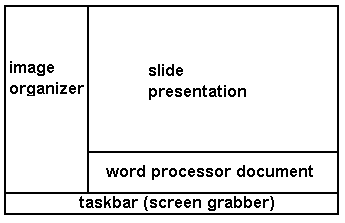
Here is how it was done from about 1995 through early 1998 (when these notes were started).
19. End of page
20. Multiple choice questions for this page
2 questions omitted (login required)
21. Acronyms and/or initialisms for this page
2 acronyms omitted (login required)
