Send
Close Add comments:
(status displays here)
Got it! This site uses cookies. You consent to this by clicking on "Got it!" or by continuing to use this website.nbsp; Note: This appears on each machine/browser from which this site is accessed.
Expected value: biased coin flips
1. Expected value: biased coin flips
A coin is flipped.
What are the possible outcomes?
What is the probability of each outcome?
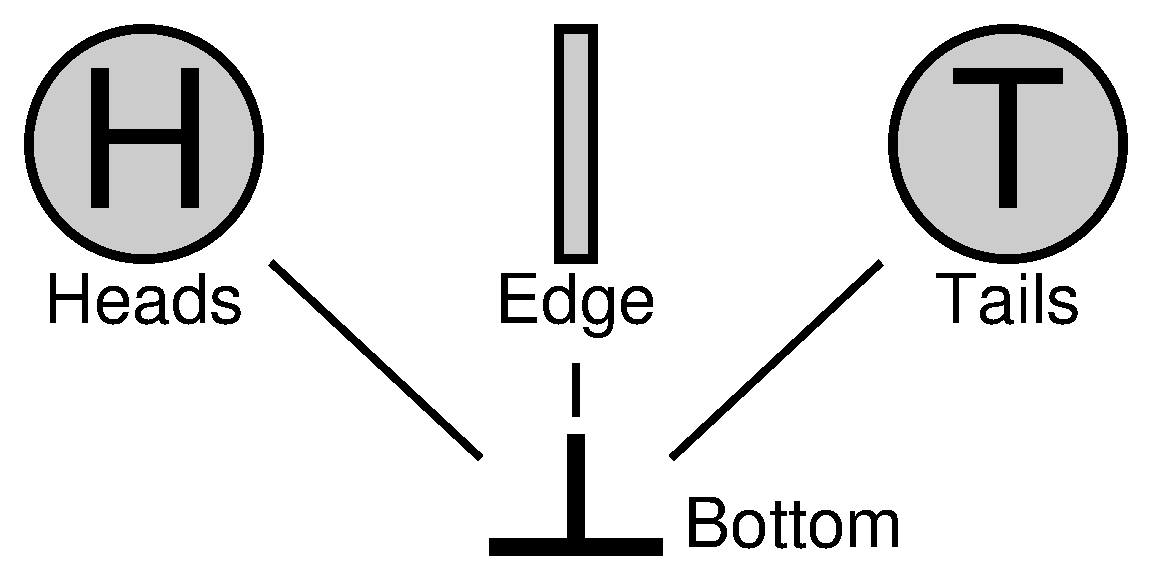
We will ignore the possibility of the coin landing on edge. The "
bottom" value "
⊥" is the state where the result is not yet known.
2. Fair and biased coins
A fair coin is a coin for which the probability of heads and tails is each 0.5.
A biased coin is a coin for which the probability of heads and tails are not each 0.5.
There is no issue with deciding an issue using a coin flip if the coin is fair.
But what if the coin is not fair
3. Trust issues
Suppose that two individuals want to use a coin flip to settle a dispute, but neither person trusts the other.
How would you use a (possibly biased) coin to perform the coin flip so that neither individual has an advantage?
4. John Von Neumann

A clever solution is due to
John Von Neumann (mathematician, computer scientist, etc.) , famous mathematician, statistician, operations researcher, computer scientist (traditional microprocessors are called Von Neumann machines), etc.
5. Biased coin
Suppose you have a biased coin that has
Prob(heads) = 0.4, and
Prob(tails) = 0.6.
Here is the method.
6. Method
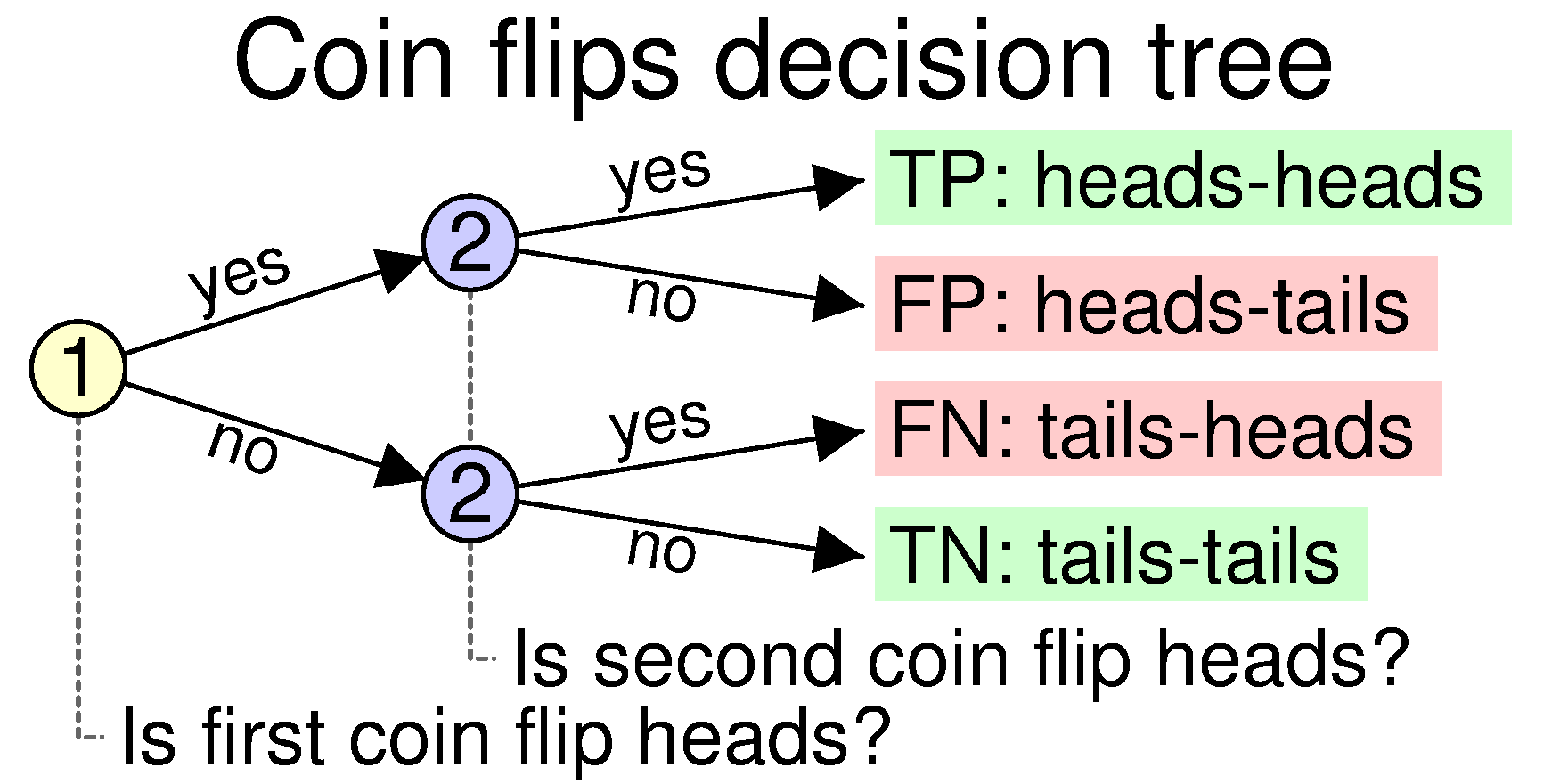
Two flips will be done.
How many possibilities are there?
7. Possibilities
There are
2*2 =
4 possibilities.
HH = Heads Heads (TP = True Positive)
HT = Heads Tails (FP = False Positive)
TH = Tails Heads (FN = False Negative)
TT = Tails Tails (TN = True Negative)
What is the
EV (
Expected Value) of each of the four cases?
8. Expected value
Here is the
EV of each possibility.
EV(HH) = 0.4*0.4 = 0.16
EV(HT) = 0.4*0.6 = 0.24
EV(TH) = 0.6*0.4 = 0.24
EV(TT ) = 0.6*0.6 = 0.36
9. Decision
The two people decide who will have Heads-Tails and who will have Tails-Heads.
Flip twice until the flips come up either Heads-Tails or Tails-Heads. If the two flips come up Heads-Heads or Tails-Tails, the flips are done again until a winner is decided.
Is this a fair way to do it?
10. Expected values
Here are the expected values of the choices.
EV(HT) = 0.4*0.6 = 0.24
EV(TH) = 0.6*0.4 = 0.24
EV(neither) = 0.6*0.6 = 0.52
Since the probability of
HT and the probability of
TH are the same, this is a fair way to do it.
How many flip pairs are needed, on average, until a winner is determined?
11. Probability estimation
What is the chance that in
10 coin flips, you will get every coin flip as specified. For example:
H H H H H H H H H H (all heads)
T T T T T T T T T T (all tails)
H T H T H T H T H T (some other pattern)
... and so on ...
The chance of getting
10 coin flips exactly as specified is
1/1024. This is about
1/1000, or
1/103.
1 / 210 = 1 / 2*2*2*2*2*2*2*2*2*2 = 1 / 1024
1 / 103 = 1 / 1000
12. General rule
In general, a probability of
1/103*m is about the same as a probability of
1/210*m. That is,
10*m coin flips. When
m is
1 then
10 coin flips.
So the following hold as quick approximations.
To convert 10m to binary, multiply m by 10and divide by 3 to get 210*m/3.
To convert 2n to decimal, multiply n by 3and divide by 10 to get 23*n/10.
So the following are quick approximations.
• 10
15 ≈ 2
50
• 10
18 ≈ 2
60
• 10
21 ≈ 2
70
• 10
24 ≈ 2
80
• 10
27 ≈ 2
90
13. Probability
What is your probability of winning the super state lottery?
14. Super lottery
Your probability of winning the super state lottery is, say, about
1/1,000,000,000, one in a billion (i.e., one chance in thousand million).
What does this mean?
Your probability of winning the super state lottery is about
1/1,000,000,000 =
1/109 =
1/103*3 which is about
1/23*10 =
1/230.
Your probability of winning the super state lottery is about the same as flipping a coin
30 times and getting the desired result on each flip.
15. Comparison
To put powers of ten into perspective, the concept of flipping a coin can be used to determine one unit of the measured quantity.
Powers Coin Measured
of ten flips quantity
--------- ----- --------
1.00*109 30 Winning the super state lottery (1,000,000,000)
3.16*107 25 Seconds in a year (60*60*24*365.25)
3.65*1012 42 Days in 10 billion years (365.25*10,000,000,000)
3.15*1017 58 Seconds in 10 billion years
1*10*1080 266 Small particles in the known universe
3.15*1097 324 Second for every particle for 10 billion years
16. Estimates
For a quick approximate conversion of a base
10 power to a base
2 power, take the power of ten, divide by
3 (i.e.,
3 powers of ten, or a thousand), and multiply by
10 (i.e.,
10 powers of
2, or just over a thousand).
1,000,000,000 (billion)
≈ 109
≈ 2(9/3)*10
= 230
So,
232 is about
4 billion.
17. Twenty questions
Many people have played the game of
20 questions.
In
20 well-chosen questions, you can pick one thing from
220 ≈ 1,000,000 things (i.e.,
20 flips).
1,000,000 = 106 ≈ 220
18. Practical limit
A practical working limit is much less than 1000 bits of information.
In general, even 200 bits of information would be highly unlikely.
19. End of page
20. Multiple choice questions for this page
12 questions omitted (login required)
21. Acronyms and/or initialisms for this page
1 acronyms omitted (login required)
